 English
 Lietuvių
 Latviešu
 Polski
 Русский
 Español
 Français
 Italiano
 Română
 ελληνικά
 Nederlands
 Deutsch
 Português
 Bokmål
 Svenska
 Suomi
Suomi
 Eesti
Eesti
 Čeština
 български
 Dansk
Dansk



Fragrance basics
How to test perfume: blotter and skin
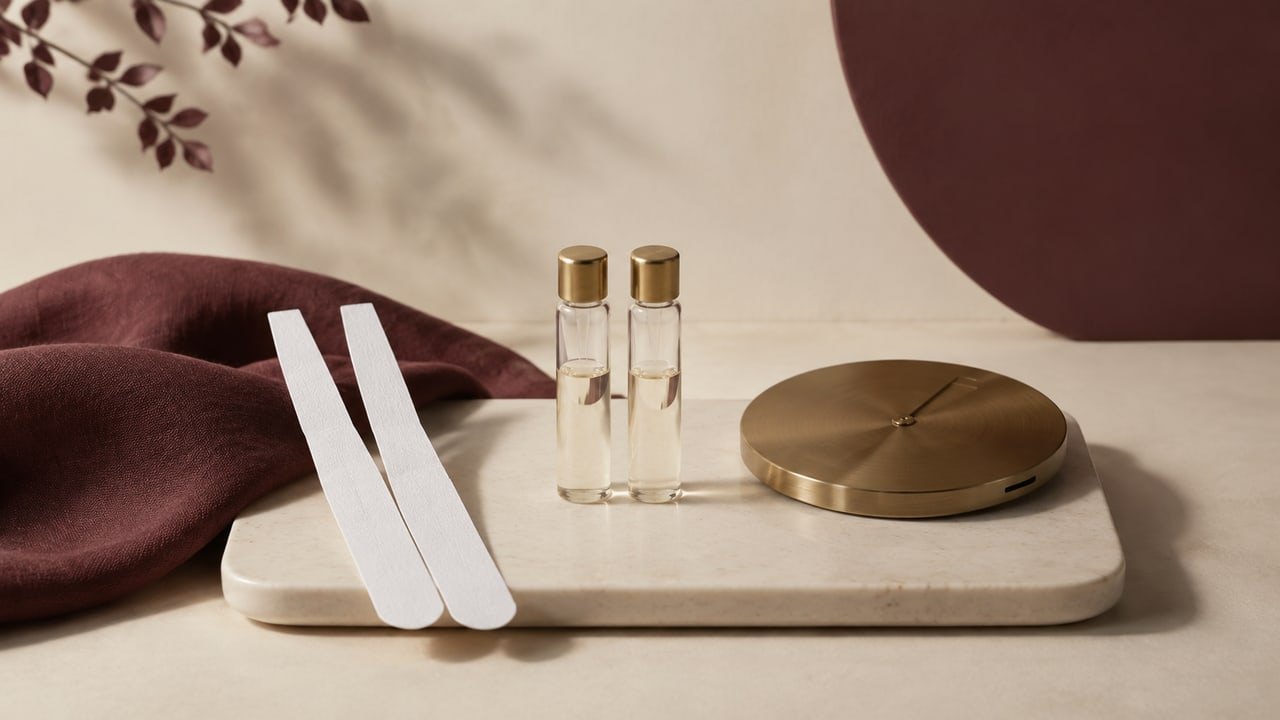
How to test perfume: start with a blotter, let the sprayed fragrance settle and shortlist those you like. Test a suitable product on skin as directed. Note what you test and where; do not rub your wrists. Revisit your impressions later and take your time deciding. Try a few fragrances; no single number is a universal r
Continue in the catalogue
3 ml perfume samples
Samples let you get to know a chosen fragrance before deciding on a larger bottle.
Perfume oil
Perfume oil descriptions help you check what the format is intended for and how to apply it.
How do you test perfume in a shop?
In a shop, start by shortlisting and leave yourself time to decide. The Perfume Society recommends using a blotter first and waiting for the initial impression to settle. A blotter helps you rule out fragrances you dislike; for a serious choice, the organisation suggests smelling the fragrance on skin.
We suggest arriving without wearing another fragrance. The study in Foods involved 19 people without specific training in fragrance assessment. Under the conditions studied, odour discrimination and detection threshold performance were poorer when participants wore a personal fragrance than when they did not. There was no significant difference in the odour identification task. We do not turn this study into a prediction of how every shop visitor will assess a particular fragrance.
Before starting, we suggest telling the adviser what you want to understand: the fragrance direction, how it changes or how convenient it is for everyday use. For example, ask to compare a fresh impression with a richer one. This question helps put the tests in order; it is not a request to prove that one product is objectively better.
You can continue your search in the sample and perfume oil categories shown in this article. The first helps you choose a smaller format for testing; the second introduces a different application base. The cards do not mean that every product in those categories will suit you.
Explore this topic in the guide: Perfume samples: how to use them.
How do you test perfume on paper and on skin?
A paper blotter is a shortlisting tool. The Perfume Society advises waiting a few minutes after spraying before assessing the fragrance. If you dislike it, you can rule it out. If it interests you, the organisation does not regard the blotter alone as sufficient for a final buying decision.
Write the name on the blotter before testing. We suggest keeping blotters separate and not spraying a new product onto one you have already used. This is a simple record-keeping practice suggested in this guide to avoid mixing up samples. It does not turn a paper test into a skin study.
When testing on skin, follow the product instructions and do not apply different fragrances to the same spot if you want to assess them separately. The Perfume Society suggests noting where each fragrance was sprayed and not rubbing your wrists. We present this as practical advice, not as a claim that rubbing “breaks the molecules”.
The chemical engineering review examines the medium of fragrance mixtures and the influence of skin separately. This is why we do not turn the impression on paper into a prediction for your skin in this guide. Nor do we claim that the base necessarily smells worse or fainter on paper.
How many perfumes should you test at once?
Start with a small shortlist. The Perfume Society suggests ideally testing no more than two fragrances on skin at once, while another sentence in the same answer says not to exceed three. The Delacourte brand blog mentions a limit of five tests. These tips define the testing situation differently; we do not treat them as a single physiological law.
This difference between the sources’ recommendations is worth knowing rather than concealing. Our simple suggestion is to try one fragrance that seriously interests you on skin per test. If you want to compare two, clearly mark the locations and do not spray them over each other. This is an editorial choice for convenience.
If the impressions become difficult to distinguish, we suggest stopping and leaving the other options for another time. The Foods study does not provide a testing limit suitable for everyone or a uniform recovery time for the sense of smell. We therefore do not specify a mandatory number of minutes after which everyone could reliably assess fragrances again.
How long should you wait before choosing a perfume?
Let the fragrance develop and return to it later. The chemical engineering review links initial, middle and late impressions to different stages of fragrance development. The Delacourte brand blog provides an example of practical advice: take your time and revisit the fragrance after a walk. We do not treat this as a validated testing method.
For this choosing exercise, we suggest at least two notes: your first impression and a later assessment, recording the actual time. If you reapplied the fragrance during the day, note that too. Such a record describes your use, but does not prove how long a single application lasts.
Distinguish three answers: “I like it”, “I can smell it close to my skin” and “it is noticeable at a distance”. The review examines fragrance performance in relation to time and distance, so the single word “strong” leaves too much unclear. Liking a fragrance does not mean another person will assess it in the same way.
The longevity of specific products was not measured for this article. Even if you like a fragrance in the evening, we do not conclude that it objectively suits every occasion. We suggest deciding based on your notes and intended use, rather than a mandatory number of hours.
How do you test perfume at home before buying online?
When choosing a fragrance for the first time, The Perfume Society emphasises the value of testing it directly on skin. An online description cannot replace that impression. A sample lets you test at a time that suits you; this guide does not suggest treating a name or list of notes alone as sufficient evidence for a choice.
At home, we suggest following the same simple routine: identify the product, use it as directed and revisit your impression later. Choose another ordinary day for comparison. Record any differences in circumstances rather than trying to recall them only when making your final choice.
This article does not propose a mandatory three-day test: we do not have data to support such a period for everyone. It is more useful to understand what you still need to find out: whether you like the later scent, whether it is convenient to use, or whether you would want to return to it. If things remain unclear, you can postpone your choice.
How do you test perfume without blotters?
If blotters are unavailable, ask for a suitable testing aid or choose another time. This guide does not establish that any paper, tissue or garment is equally suitable for testing. This article contains no comparison of such surfaces. Do not assume an unfamiliar material is neutral simply because it is white.
If you decide to test directly on skin, read the instructions first. We suggest choosing one product, noting the location and not rubbing. If you do not want to or cannot test on skin, there is no need to do so just because you feel rushed to choose. You can return to shortlisting later.
Choosing a fragrance is not an allergy diagnosis. DermNet explains that fragrance allergy is assessed medically, including through patch testing. If you suspect a reaction, stop testing and consult a doctor. This text is not medical advice and does not suggest checking for an allergy with another fragrance.
Explore this topic in the guide: Longevity, projection and sillage.
How can recording your impressions make choosing easier?
We suggest starting with four short fields: product and version, application location, time and impression. Describe the impression in your own words: “drier than I expected”, “I like the opening, but it gets too sweet later” or “I want to try it again”. These are sample phrases, not properties of any particular products.
In your later entry, do not simply repeat a note from the description. Record what you notice yourself and what you cannot decide. If you could not smell the fragrance but did not ask anyone else, leave it at that: “I cannot smell it myself at the moment”. This is more accurate than concluding “no one can smell it any more”, for which you have no data.
Before comparing two entries, check that you compared similar things. The first minutes of one test and the evening of another are not the same observation point. If the setting or use differs, note the difference. These notes are meant to make deciding easier, not to turn a personal test into a laboratory.
For your final decision, choose one unanswered question and devote the next test to it. For example: do I still like the later impression? There is no need to keep expanding your shortlist. Sometimes it is enough to calmly revisit the same sample, keeping clear notes and using it as directed.
State what you want
Write down the fragrance impression and use you are looking for.
Get ready
Do not apply another fragrance before shortlisting.
Shortlist with a blotter
Wait after spraying and rule out the options you dislike.
Read the instructions
Check the product’s directions for use before testing on skin.
Record the test
Note the product, location and time; do not rub your wrists.
Return later
Add to your notes and record any reapplication.
Make your decision
Distinguish liking the fragrance from how noticeable it is and how convenient it is for everyday use.
- I know which product and version I tested.
- I recorded the time and application location.
- I did not mix samples on the same spot.
- I have a first and a later impression.
- I do not treat a personal impression as a guarantee of measurement accuracy.
Can you rub your wrists after spraying?
The Perfume Society recommends not rubbing them and letting the fragrance develop. This is practical advice; this guide does not claim that rubbing destroys fragrance molecules.
Does the same number of tests suit everyone?
We do not establish such a number in this article. The Perfume Society and Delacourte give practical limits defined in different ways. Starting with one skin test is our suggestion for convenience.
Is the first impression enough to decide?
Your impression of a fragrance can change, so we suggest returning to it later. Do not compare your first and later assessments without noting whether you reapplied it.
Can you choose a fragrance entirely online?
A description helps you shortlist, but The Perfume Society emphasises direct testing when choosing. A sample lets you do this at home, following the product instructions.
What should I do if I suspect a skin reaction after testing?
Do not try to identify the cause by switching fragrances or comparing their origins. Stop testing and consult a doctor. A fragrance sample is no substitute for medical assessment.
Related articles
Sources and editorial methodology
- Testing a Perfume: The 10-Step Expert Protocol
- Fragrance allergy
- Perfume and Flavor Engineering: A Chemical Engineering Perspective
- Should Panelists Refrain from Wearing a Personal Fragrance Prior to Sensory Evaluation?
- FAQs: choosing, testing, applying and storing perfume
- MARABIKA editorial recommendations and their limits
- Perfume samples — public category identity — MARABIKA catalogue observation, 2026-09-05
- Perfume oils — public category identity — MARABIKA catalogue observation, 2026-09-05