 English
 Lietuvių
 Latviešu
 Polski
 Русский
 Español
 Français
 Italiano
 Română
 ελληνικά
 Nederlands
 Deutsch
 Português
 Bokmål
 Svenska
 Suomi
Suomi
 Eesti
Eesti
 Čeština
 български
 Dansk
Dansk



Fragrance Notes Encyclopedia
Amber in Perfume: How Does an Amber Accord Differ from Ambergris?
Amber in perfume can mean an amber accord or ambergris, so read the full description. A blend of labdanum and vanillin, possibly enriched with benzoin, is not a sperm-whale-derived material. Note names do not confirm the full formula. Ambergris legality varies by country: the EU exception is conditional, while NOAA sta
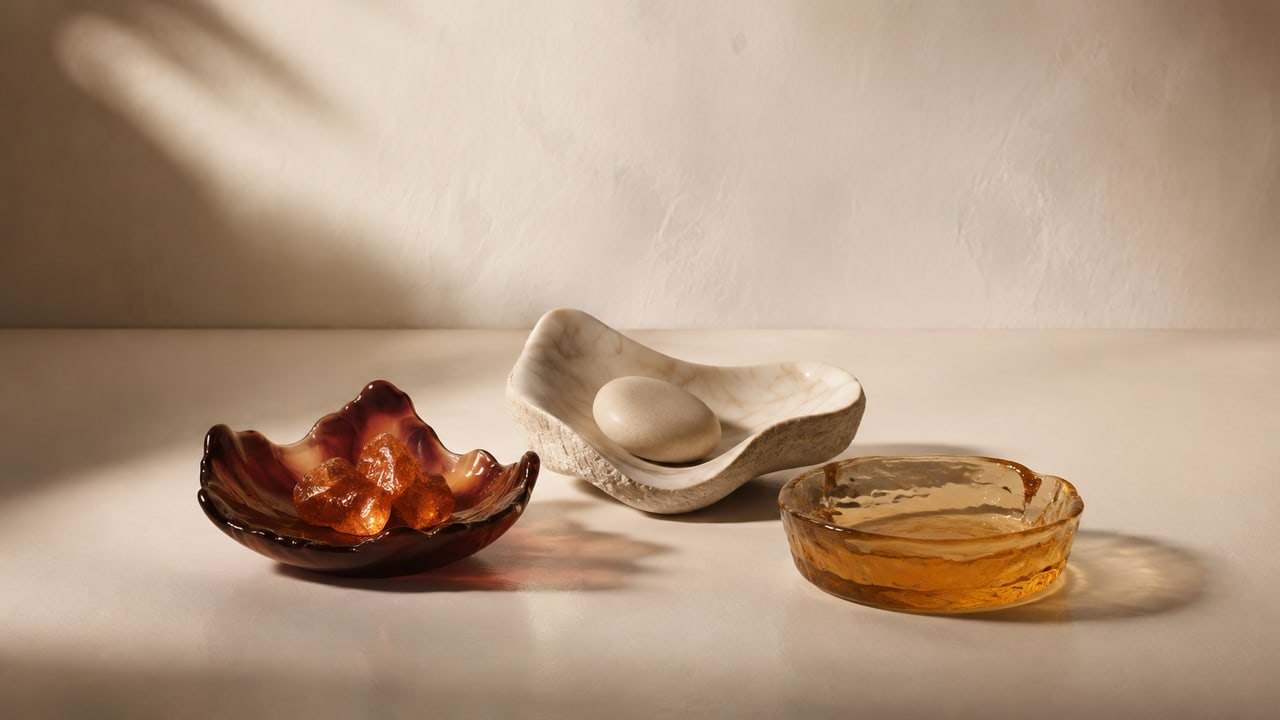
What is amber in perfume?
The word “amber” in a perfume description can be misleading if you do not check the context. In Maison Francis Kurkdjian’s glossary, the English term amber is described as an accord and distinguished from animal-derived ambergris. We use this source as an example of terminology explained by a clearly identified brand. Therefore, the first question should not concern amber’s supposed single scent, but which meaning is intended.
When reading a note list, make a note of the original term. If it says only “amber,” look for a fuller explanation from the manufacturer. Do not infer from this word alone that the perfume contains a sperm-whale-derived material. Nor should you describe the entire formula as plant-based: that conclusion would require separate confirmation.
This distinction is also useful when comparing two descriptions. One may refer to the composition’s warm character, while the other may refer to a specific raw material. Record them separately so that a similar name does not become a misleading comparison of their compositions.
What is an amber accord made from?
The basis of the amber accord described by Maison Francis Kurkdjian is labdanum and vanillin; benzoin is listed as one possible addition. Labdanum is associated with a warm, resinous character, and vanillin with a sweet vanilla accent. This is the explanation provided by that brand, not a formula rule for all amber compositions.
This is not a recipe with mandatory proportions of three materials. When you read “labdanum, benzoin, vanillin,” you can recognize the logic of the accord being described, but you cannot reconstruct the formula of a particular bottle from it. Assess separately which element is most perceptible in your chosen fragrance.
For comparison, make a simple note: sweetness, resinousness, overall impression. For each point, record your own observation rather than a predetermined answer. If you do not recognize an accent promised in the description, record that as well. Include uncertain impressions too—you are not required to identify every listed note.
What is ambergris, and where does it come from?
The Natural History Museum links ambergris to the sperm whale’s digestive system and hard-to-digest parts of its prey. The museum explains that the way the substance is expelled remains a matter of debate. The popular label “whale vomit” is therefore not an accurate explanation for every case.
This material of biological origin must be distinguished from the amber accord discussed earlier. The account involving the sperm whale does not explain the composition of every perfume whose description includes the word amber. If animal-derived ingredients matter to you, ask about the specific product and the information provided by its manufacturer.
A practical way to ask is: “In this description, does amber refer only to a fragrance accord, or does the manufacturer confirm the use of ambergris?” This is clearer than asking whether the amber is real. The latter can refer both to the scent impression and the raw material’s origin, so an answer without clarification can easily mislead.
What does ambergris smell like?
According to the museum’s description, fresh ambergris has a strong fecal odor, while drying gives it a more pleasant musky character. This means that its condition matters even when discussing the material itself. This description should not be applied directly to finished perfumes.
When testing a composition, write down what you actually perceive: for example, a sweeter, drier, or hard-to-define impression. These questions are intended for your observation; they are not a promise that every version must have all these characteristics. Describing a scent and confirming its composition must remain separate matters.
Is ambergris permitted in the EU and the US?
Point 15 of the interpretation of the annex amended by EU Regulation 2026/1383 provides an exception for ambergris that is a waste product and was obtained without manipulation of the animal concerned: the Regulation does not apply to it. This conditional wording is not a general authorization for any trade or import.
In the United States, NOAA Fisheries states that ambergris may not be collected, kept, or sold because it is part of an endangered marine mammal. The guidance also covers material found onshore. The US rule cannot be replaced by the EU exception simply because both concern the same term.
In this edition, the cited legal sources were consulted on September 7, 2026. If the question concerns a specific shipment or raw material, clarify its origin, route, and the applicable rules with the competent authority. This overview is not legal advice and does not confirm the legality of a specific transaction.
What can amber’s place in the note pyramid help you understand?
Read the note pyramid together with the full description provided by the specific manufacturer. The framework below is intended to help organize questions, not to show the development of a tested formula. It does not establish when amber should emerge or how many hours it should last.
If you want to compare several options, use a separate note for each one. Record the fragrance name, testing time, and your impression. When you return to the note later, consider what you liked and what remained unclear. This article contains no results from a conducted test, assessor scores, or universal longevity figure.
Explore this topic in the guide: Perfume Notes: How to Read the Pyramid.
How can you search for the amber note in the catalog?
In the catalog, start with the notes and description of the specific product. A category link helps with browsing, but does not itself confirm the use of ambergris. Assess your chosen option using the information provided for it.
Before comparing options, write down what you are looking for: a sweeter direction, a more resinous impression, or simply an understanding of an unfamiliar note. Then ask what information about it is provided in the specific description. If there is no answer, leave the question open instead of filling the gap with an assumption.
To explore the terminology further, go to the fragrance notes encyclopedia and the topic on vanilla. A separate guide covers the testing plan. This allows you to base your fragrance choice on both a clear glossary and your own notes, without confusing either with laboratory identification of the composition.
Explore this topic in the guide: Fragrance families and the fragrance wheel: classification explained in English.
top
heart
base
Are amber and ambergris the same thing?
No. The first term can refer to an accord; the second, to an animal-derived material.
Is benzoin required in every amber accord?
MFK lists it as a possible addition; this is not a rule for all formulas.
Does the note list confirm animal origin?
The word “amber” alone is not enough. A specific explanation from the manufacturer is needed.
Has amber’s longevity been measured here?
No. An explanation of the terms and a reading framework are provided.