 English
 Lietuvių
 Latviešu
 Polski
 Русский
 Español
 Français
 Italiano
 Română
 ελληνικά
 Nederlands
 Deutsch
 Português
 Bokmål
 Svenska
 Suomi
Suomi
 Eesti
Eesti
 Čeština
 български
 Dansk
Dansk



MARABIKA Journal
Oud (agarwood): what it is, what it smells like and what its note means in perfume
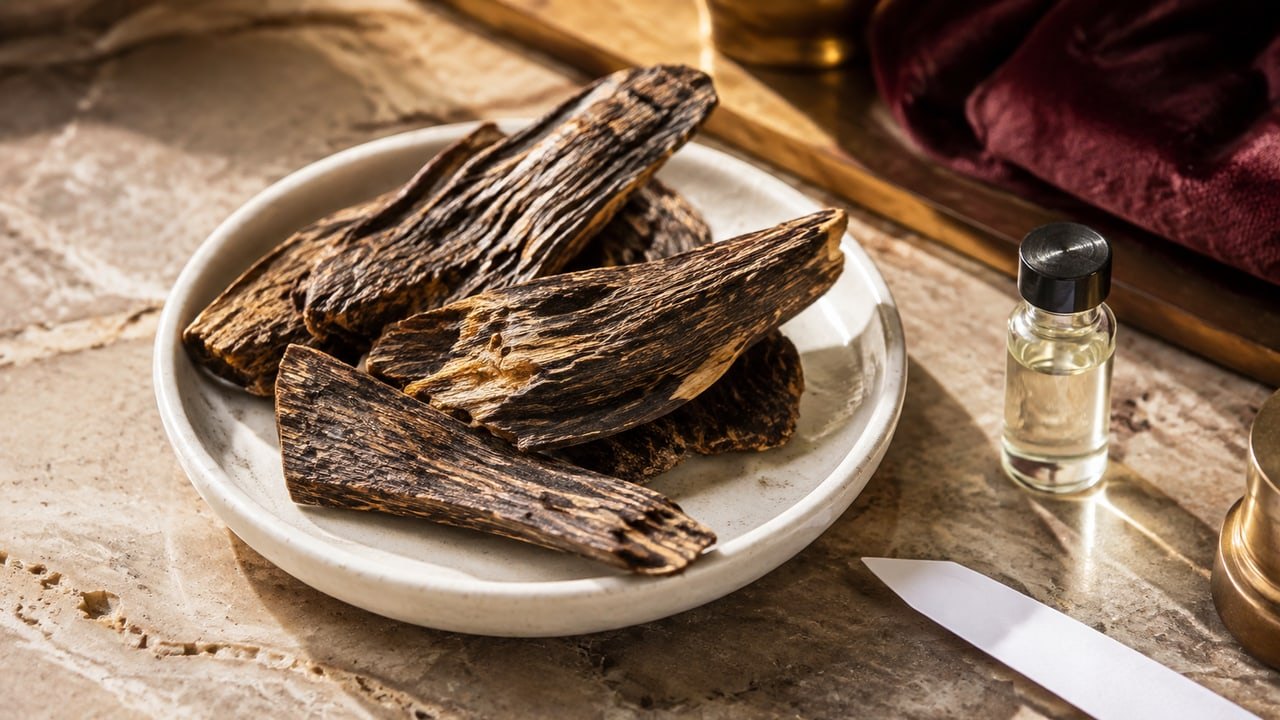
What is oud? Also called agarwood, it is resinous wood formed as an Aquilaria tree responds to injury and biotic or abiotic stress. The IFRA glossary describes agarwood oil as woody, animalic and smoky. Yet an oud note alone does not confirm a specific raw material or origin. This guide distinguishes wood, oil and a co
What is oud?
The 2022 scientific review “Agarwood—The Fragrant Molecules of a Wounded Tree” links agarwood formation to injury in an Aquilaria tree and to biotic or abiotic stress. The tree's defence response includes oleoresin production; as the resinous wood forms, it darkens. The review lists India, New Guinea, China's Hainan Island and countries in Southeast Asia as areas where Aquilaria occurs.
As you read this guide, distinguish the name of the raw material from the scent description: “agarwood” means the resinous wood, “agarwood oil” means the raw material, and here we use “oud accord” for a constructed impression of the scent of oud. This working distinction is not a conclusion about the composition of any specific product. Note names do not tell us whether a formula contains natural agarwood oil.
How does agarwood form?
The review cited above quotes an estimate that about 10% of wild Aquilaria trees are infected and produce resin. This is an estimate from an earlier source presented in the review, not a count conducted by us or one confirming the current status of all populations.
The review separately describes an experiment by “The Rainforest Project” (TRP) in Vietnam: trees were drilled, their wounds were kept open with plastic tubes, and chemicals were used to stimulate resin production. It is specifically this experiment that is reported to have produced agarwood ten times faster than it forms naturally. We do not extend this ratio to all artificial induction technologies, nor draw from it a general conclusion about raw-material quality or the legality of trade.
What does oud smell like?
IFRA's 2020 Fragrance Ingredient Glossary gives the descriptors “Woody,” “Animal Like” and “Smoky” for agarwood oil and extract—woody, animalic and smoky. These describe a specific raw material; they are not a standard for the scent or longevity of every perfume marketed as oud. The Molecules review links sesquiterpenes to the scent of agarwood and also discusses 2-(2-phenylethyl)chromones. It associates a warm, balsamic and sweet aroma with burning agarwood; we do not automatically extend that description to the oil.
If oud appears in a note description, read it alongside the other notes and the manufacturer's explanation. The editorial team suggests recording your initial and later impressions separately; we do not assume a uniform development time or longevity for every oud fragrance.
Explore this topic in the guide: Amber in Perfume: How Does an Amber Accord Differ from Ambergris?.
Top notes
Heart notes
Base notes
Natural oud and an oud accord: what can a description tell you?
Article 19 of Regulation (EC) No 1223/2009 provides that perfume and aromatic compositions and their raw materials are to be referred to in the list of ingredients by the terms “parfum” or “aroma”; requirements to list the relevant substances in Annex III separately also apply. The entry “parfum” alone does not reveal whether agarwood oil was used. This does not mean that no other information from the manufacturer can clarify the composition.
If the natural raw material itself matters to you, look for a specific explanation from the manufacturer about the material used and its origin. Record what the document actually confirms and what remains unclear. In this guide, bottle size, the sprayer or the scent development you observe are not treated as a test for determining the origin of the raw material.
In this article, we did not compare natural oil and accords in terms of stability, price, popularity or environmental impact. We suggest basing your choice on information about the specific product and your personal impression of its scent.
| Question | Agarwood oil | Oud accord |
|---|---|---|
| What are we distinguishing here? | A specifically named raw material. | A constructed scent impression. |
| What information should you look for? | Manufacturer information about the material and its origin. | An explanation of whether the text describes notes or discloses ingredients. |
| What does the name alone not confirm? | The legality of a specific shipment or a perfume's complete formula. | Whether a natural raw material is present or absent, or its environmental impact. |
Agarwood and CITES: important exceptions
Australia's official CITES species list gives 16 February 1995 as the date when Aquilaria malaccensis was first listed. We use this document for the historical date. In the Annex to EU Regulation 2026/1383, Aquilaria spp. and Gyrinops spp. are shown in the Annex B column with the annotation “(II) #14”.
Annotation #14 covers parts and derivatives, subject to exceptions. One is for finished products packaged and ready for retail trade; this exception does not apply to wood chips, beads, prayer beads or carvings. A uniform rule that “a permit is required” therefore cannot be applied to all products, nor can the word “plantation” be treated as an adequate substitute for documentation. For questions about a specific shipment, the form of the raw material and the applicable documents, contact the responsible CITES authority. This text is not legal advice and does not confirm the legality of any specific product.
Agarwood in fragrance culture
The 2022 review describes the use of agarwood in perfumery, as incense, and in cultural and religious ceremonies. This is broader context on its uses; we do not infer from it that every individual or an entire region observes the same daily ritual. Nor does it confirm that all Arabic oud perfumes are designed for the same climate or have the same longevity.
When choosing a specific fragrance, read its description. Do not treat a category or brand name alone as confirmation of the presence or quantity of natural oud material.
Explore this topic in the guide: Saffron in perfume and safranal.
How should you choose your first oud perfume?
The editorial team's suggestion for a first encounter: choose a description that includes other notes you recognise and find interesting, such as rose or vanilla. Record your initial and later impressions while following the specific product's directions for use. This is an exploration exercise, not a validated method for identifying a natural raw material; we do not prescribe a single mandatory waiting time.
Choose a description that interests you
Note which terms—wood, smoke or sweetness—caught your interest.
Distinguish between testing surfaces
If you test on a strip and on skin, record your impressions separately; follow the product's directions for use.
Record the time
Write down when you assessed the fragrance, and compare your initial and later impressions.
Check the sample offer
If you choose a sample, check its description for the volume, format and availability; we do not promise a fixed number of tests.
Frequently asked questions about oud
Is oud perfume suitable for women?
Choose according to the scent description that interests you and your personal impression. The editorial team does not suggest limiting this exploration by gender; this is guidance for choosing, not a generalisation about usage traditions in all regions.
What is the difference between oud oil and oud perfume?
In this guide, we distinguish a raw material specifically identified as agarwood oil from a perfume composition. Check the manufacturer's information for the composition, dilution and use of a specific oil or perfume offered for sale—the name alone does not confirm purity.
Are oud perfumes natural?
An oud note alone does not confirm that. The entry “parfum” in the ingredient list also does not reveal the formula of a specific fragrance composition; look for the manufacturer's explanation of the raw materials used.
Can oud perfumes be used during pregnancy?
This article is not medical advice and does not assess whether a specific product is suitable for use during pregnancy. Consult a doctor about personal use and follow the product warnings.
How should oud perfume and oil be stored?
Follow the storage and usage instructions for the specific product. If you notice any changes or have doubts about the product's condition, contact its manufacturer. This guide does not provide an at-home test capable of confirming safety or authenticity.
Continue in the catalogue
Related articles
Sources and editorial methodology
- Agarwood—The Fragrant Molecules of a Wounded Tree
- IFRA Fragrance Ingredient Glossary (April 2020)
- Commission Regulation (EU) 2026/1383 amending Council Regulation (EC) No 338/97 (Annexes)
- EPBC List of CITES Species for the Purposes of the Act — compilation 30, 7 February 2025
- Regulation (EC) No 1223/2009, 30 November 2009; consolidated text dated 18 May 2026
- MARABIKA editorial policy and source hierarchy