 English
 Lietuvių
 Latviešu
 Polski
 Русский
 Español
 Français
 Italiano
 Română
 ελληνικά
 Nederlands
 Deutsch
 Português
 Bokmål
 Svenska
 Suomi
Suomi
 Eesti
Eesti
 Čeština
 български
 Dansk
Dansk



Fragrance Notes Encyclopedia
Saffron in perfume and safranal
Saffron in perfume refers to a fragrance note associated with the saffron spice. Safranal is an important component of its aroma, but several compounds create the overall scent. Other molecules can also evoke saffron in perfumery. The note name therefore does not prove that natural stigmas were used, nor can a single n
Continue in the catalogue
Oriental perfumes for men
In the oriental fragrances for men group, look for explicitly named notes without attributing them to the entire category.
Arabic perfumes
In the Arabian perfume catalogue, compare different product formats and combinations of notes.
What is saffron in perfume?
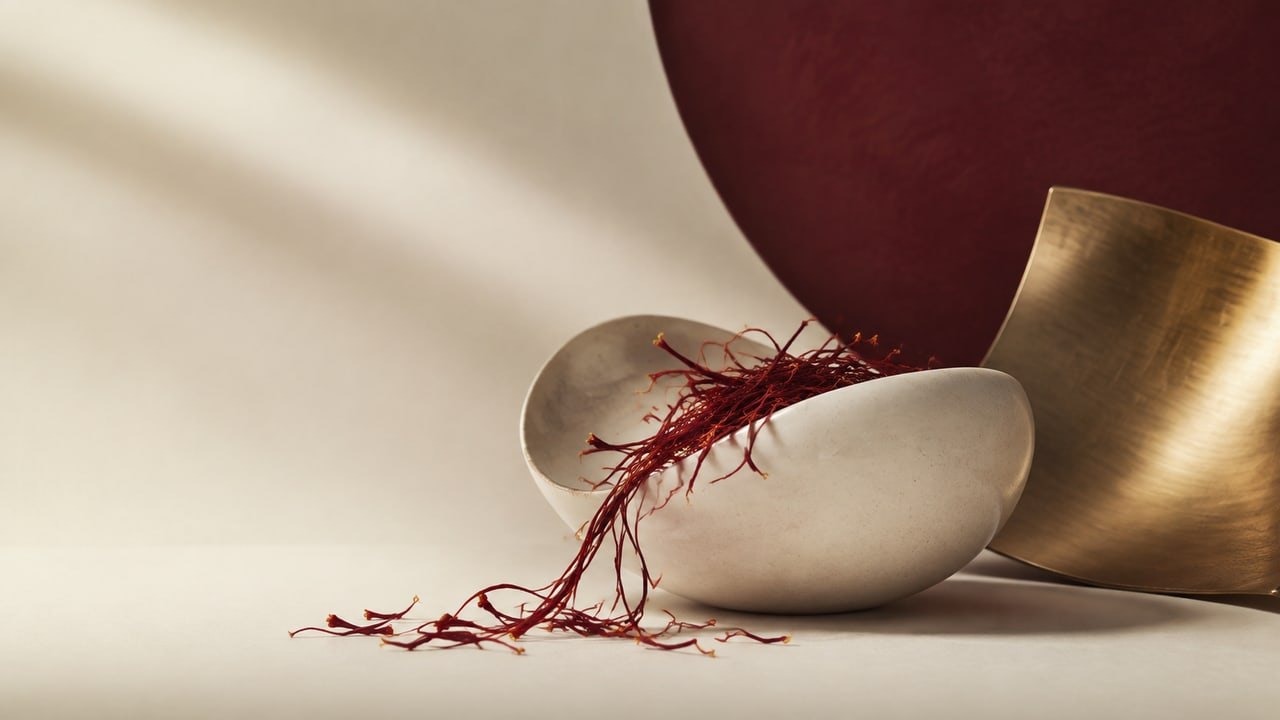
It is the name of a fragrance note and should be distinguished from the raw material itself. The saffron spice is obtained from the dried stigmas of the Crocus sativus flower. A stigma is the part of a flower on which pollen lands. The botanical raw material and a perfumery accord reminiscent of its aroma are not the same level of description.
In this article, an accord means a combination of aromatic substances that creates an overall impression. For example, Givaudan describes its Safraleine material as reminiscent of natural saffron. This example shows why the name of a note alone does not reveal whether flower stigmas, their extract or another ingredient were used.
Crocus sativus belongs to the iris family. A review reports cultivation in Iran, India and Greece. These are data on the plant's distribution in cultivation, not a certificate of origin for the raw material in a particular perfume. A saffron note alone is therefore insufficient to attribute the bottle's raw material to Iran or Kashmir.
What is safranal and what does it smell like?
Safranal is one of the most important compounds in saffron's odour. An older botanical review associates the aroma with impressions of hay and iodoform. A more recent review of drying stresses that saffron's characteristic odour comprises several volatile compounds, not safranal alone.
Use scent descriptors such as “hay”, “herbaceous” or “spicy” as reference points when trying a fragrance yourself. They are not a list of the product’s ingredients. Record what you actually smell, rather than trying to recognise a particular word from the description at all costs.
Safranal is not the same compound as Safraleine. PubChem gives C10H14O as the formula of safranal, while Givaudan's Safraleine page gives C12H14O. They are different molecules, although both descriptions refer to a saffron direction. A similar odour word does not mean the same chemical identity.
What is the difference between safranal and crocin?
Safranal is associated with aroma, crocin with colour and picrocrocin with bitterness. A botanical review distinguishes saffron's main sensory properties in this way. This short explanation does not, however, mean that only one substance determines the spice's entire odour.
Drying changes the profile of saffron's volatile compounds. Reviews discuss the formation of safranal in connection with processes involving the breakdown of picrocrocin. When discussing the aroma, the processing of the raw material must therefore also be stated. An image of a fresh flower does not by itself explain the odour of the dried spice.
It is useful for a buyer to distinguish the impression of colour from that of odour. A yellow liquid or a red bottle is not a test identifying the raw material. If you want to know where an ingredient was obtained, look for a clear declaration from the manufacturer. Reserve colour for describing appearance and note lists for guidance on scent.
How are safranal and saffron accords used in perfumery?
Individual ingredients can evoke a saffron character. Givaudan’s description of Safraleine combines warm, spicy, leathery, tobacco and woody aspects, and links its spiciness to natural saffron. This is a description of a perfumery ingredient provided directly by its manufacturer.
The Safraleine example does not justify stating that this material is present in every saffron perfume. Still less does it reveal the percentages of a particular formula. The table therefore separates the plant, the molecule and the accord: understand the concept first and then check the declaration for the selected product.
Even the word “saffron” in advertising is insufficient to establish natural origin. Ask for information about the actual raw material and its origin if that determines your choice. If the manufacturer lists only notes, you can assess the direction it describes, but do not construct the missing formula yourself.
How should you read a perfume note list that includes saffron?
A fragrance pyramid groups notes into the opening, heart and base. In this article it is a reading aid, not a universal evaporation chart for saffron. Sources on safranal chemistry cannot simply be transferred to the pyramid of a finished perfume.
First, note where the manufacturer places saffron. Then read the surrounding notes and smell the composition as a whole. The editorial team suggests comparing the opening with a later impression: do you detect dry spiciness, a leathery nuance or another character? Record your answer in your own testing notes.
We did not measure longevity or sillage for this article. Givaudan provides data on an individual ingredient’s tenacity on a scent strip. We do not apply these data to finished perfumes or present them as MARABIKA measurements. In this article, “not measured” means that we do not provide the corresponding test results.
Explore this topic in the guide: Perfume Notes: How to Read the Pyramid.
Where can you look for a saffron scent in perfume?
In the archive of MARABIKA’s oriental perfumes for men category page dated 5 September 2026, the note navigation included “Saffron”. This is a recorded catalogue search label, not confirmation of the current product range. The adjacent card for the broader category is titled “Oriental and Arabian perfumes”.
If you see a saffron filter on the category page, you can start your search there and compare manufacturers’ descriptions. If you are looking for dry spiciness or a leathery impression, record this preference separately from the word “saffron”. You can use this note when discussing your choice.
This article does not call saffron the signature of all Arabian perfumery. The botanical and ingredient sources reviewed do not establish such a historical or statistical claim. The article addresses the raw material, the description of the scent and how to find it, not the composition of every fragrance from the region.
Explore this topic in the guide: Oud (agarwood): what it is, what it smells like and what its note means in perfume.
| Criterion | Saffron raw material | Safranal | Saffron accord |
|---|---|---|---|
| What it is | Dried stigmas of Crocus sativus | Individual compound C10H14O | Combination of aromatic substances |
| Explanation of the odour | Aroma of several compounds | An important aromatic compound in the raw material | Depends on the selected ingredients |
| What the note name proves | Does not confirm origin | Does not confirm use | Indicates the direction being described |
top
heart
base
Longevity
not measured
Sillage
not measured
Intensity
not measured
The note name helps you search for a scent but does not reveal the formula.
What is safranal?
It is an important aromatic compound in saffron. PubChem gives the formula C10H14O. The raw material's entire aroma does not consist of this compound alone.
Are safranal and crocin the same?
No. The review associates safranal with aroma, crocin with colour and picrocrocin with bitterness.
Does “saffron” in a note list mean natural raw material?
The note name alone is insufficient. A separate molecule described by Givaudan, Safraleine, also has a saffron direction. The raw material in a particular product must be checked separately.
Do perfumes with a saffron note all last the same length of time?
The sources for this article do not support that conclusion. MARABIKA did not measure longevity or sillage for this article.
Sources
- The Relation between Drying Conditions and the Development of Volatile Compounds in Saffron (Crocus sativus)
- Arabian perfumes: category navigation — MARABIKA catalogue observation, 2026-09-05
- Oriental perfumes for men: category navigation — MARABIKA catalogue observation, 2026-09-05
- MARABIKA: editorial decisions for this revision (unpublished)
- Crocus sativus L.: a comprehensive review
- Safraleine: a fragrance molecule
- Safranal, CID 61041: molecular formula and IUPAC name