 English
 Lietuvių
 Latviešu
 Polski
 Русский
 Español
 Français
 Italiano
 Română
 ελληνικά
 Nederlands
 Deutsch
 Português
 Bokmål
 Svenska
 Suomi
Suomi
 Eesti
Eesti
 Čeština
 български
 Dansk
Dansk


MARABIKA magazine
Attar (ittar): the history, composition and use of oil fragrances
What is attar? Attar (ittar) is associated with oil fragrances; the historical Arabic term ʿiṭr means perfume. Amouage describes its attars as pure fragrance oil, but this example cannot define every product. Check labels for alcohol and application instructions. This article does not establish slower development or we
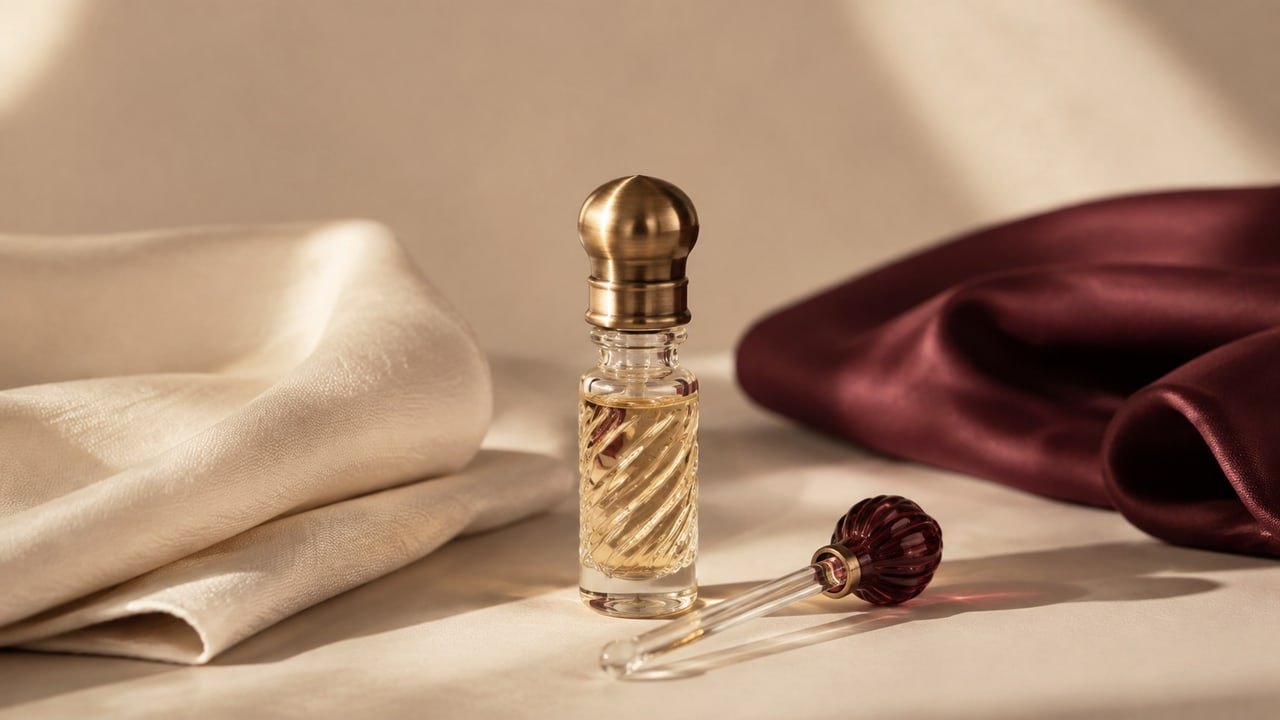
What is attar and what does the word mean?
English Wiktionary defines attar as an essential oil extracted from flowers and a perfume made from it, and lists ittar as an alternative form of the same word. This dictionary definition does not determine the composition or applicator of every product sold today.
According to that dictionary, attar entered English from Persian, which borrowed it from Arabic ʿiṭr, meaning perfume. The Arabic entry gives the senses perfume, scent and essence. Encyclopaedia Iranica defines ʿaṭr as perfume and describes its historical use for different forms of fragrant preparations, rather than one recipe.
This magazine consistently uses the spelling attar. When reading a specific offer, note the name, ingredients and application format separately. Do not treat the origin of the word as evidence of what a particular bottle contains.
Explore this topic in the guide: Oud (agarwood): what it is, what it smells like and what its note means in perfume.
How does attar differ from spray perfume and from mukhallat?
Separate two questions: what the product contains and how it is used. Amouage describes its attar collection as pure fragrance oil worn close to the skin. This is one perfume house’s description, not a rule for all attars. This article does not compare the sillage or longevity of oil and spray formats.
If the description also uses the name mukhallat, read the manufacturer’s explanation of the blend and its use. The Arabian perfumery glossary guide discusses this term separately. We do not consider a similar name sufficient grounds to attribute the same composition to two products.
This article provides no shop observations or data on how often the name attar is applied to different formulas. If the presence of alcohol or a particular natural raw material matters to you, look for the product’s ingredient information and the manufacturer’s explanation.
| Question | What to look for in the description |
|---|---|
| Composition | Check the ingredients of the specific product and the manufacturer’s explanation; the format does not replace this information. |
| Use | Follow the instructions for that product’s applicator and use. |
| Sillage and longevity | We did not measure these formats for this article and do not promise identical results. |
How is attar traditionally made?
A historical example of production appears in a 1986 UNIDO report on the perfumery industry of Kannauj, India. It describes the distillation of plant material, mainly flowers, with water in “Dag Bhapka” apparatus. Vapour is directed into a cooling tube and a receiving vessel kept in water. The base oil in that vessel, either sandalwood or paraffin oil, absorbs the flower oil.
This is the account given in a particular historical report. It does not establish that every current attar is made this way or that the base is always sandalwood oil. Check the production method and materials against the documentation for the specific product.
We present a modern example of the oil format separately: Amouage’s collection description refers to pure fragrance oil. We do not combine a historical technique and a modern manufacturer’s use of a name into one recipe that every product must follow.
Top notes
Heart notes
Base notes
How is attar used and how should you choose one?
In its example of how to use attar, Amouage suggests placing a drop on a fingertip, gently rubbing the fingers together and sweeping over the desired areas: pulse points, the collarbone or behind the ears. We present this only as one manufacturer’s instruction; for another product, follow its own label and directions for use.
The abstract of the paper by Kasting and Saiyasombati describes a model that estimates the evaporation and skin absorption of fragrance materials, accounting for temperature and air movement. This is not an attar test we conducted, and it does not prove that the same drop will always smell stronger or last longer in warmth. The editorial team suggests noting the test conditions alongside your impressions.
For a first introduction, choose a description that includes notes you are interested in. Assess your own impression while following that product’s directions for use. This is an editorial suggestion, not a validated method for finding the right fragrance for everyone.
Explore this topic in the guide: How to use perfume oils.
What does an attar label tell you?
Article 19 of EU Cosmetics Regulation 1223/2009 sets out labelling requirements. The information includes the responsible person’s identity and address and a list of ingredients; the article also provides conditions and exceptions for how particular information is presented. Where minimum durability exceeds 30 months, the period-after-opening (PAO) rule applies, except where the concept is not relevant to the product. We therefore do not assign the same date or PAO-symbol requirement to every perfume oil.
Article 19 provides for perfume compositions and their raw materials to be labelled “parfum” or “aroma”, with the relevant Annex III substances listed separately. “Parfum” alone does not reveal the full fragrance formula. For the substances specified in the Annex to Regulation 2023/1545 that have a transition period, products meeting the previous restrictions applicable on 15 August 2023 could be placed on the EU market until 31 July 2026 and may be made available on the market until 31 July 2028. This is not an exemption for any kind of product non-compliance.
Read the specific product’s label and the manufacturer’s information. This text is not legal advice or confirmation of a particular product’s compliance. Consult a doctor about personal use and skin sensitivity: this article is not medical advice.
First read the specific product’s directions for use and record your impression. This is an editorial suggestion, not the result of a completed test.
— MARABIKA editorial team
Frequently asked questions
Ittar or attar—which is more correct?
Wiktionary lists ittar as an alternative form of attar. The magazine consistently uses attar; a spelling variant does not itself tell you what a specific product contains.
Is attar always alcohol-free?
Do not rely on the name alone. Check the specific product’s ingredient list and the manufacturer’s explanation of alcohol and the base used. This guide does not claim that every attar is alcohol-free.
Does attar mean a natural product?
The name alone does not confirm this. Distinguish the note description from ingredient information; “parfum” alone does not reveal the full fragrance formula either.
How much attar should you use and where should you apply it?
Follow the specific product’s instructions. For its collection, Amouage gives an example involving one drop on a finger and application to chosen areas. We do not treat this as a universal dose for every product.
How should attar be stored?
In its general perfume-storage guidance, The Perfume Society recommends avoiding light and heat. For a particular oil, follow its storage and use instructions; date and PAO labelling are subject to the regulation’s conditions and exceptions.
Continue in the catalogue
Related articles
Sources and editorial methodology
- Wiktionary: attar (English entry)
- Wiktionary: ittar
- Wiktionary: عطر (ʕiṭr)
- ʿAṬR
- The New Attars
- Regulation (EC) No 1223/2009, 30 November 2009; consolidated version of 18 May 2026
- Regulation (EU) 2023/1545, 26 July 2023
- Kasting & Saiyasombati—model of perfume evaporation from the skin (PubMed 18503438)
- Discover perfume—FAQ (storage)
- Assistance to the Perfumery Industry of Kannauj District, India — Terminal Report, 27 November 1986